
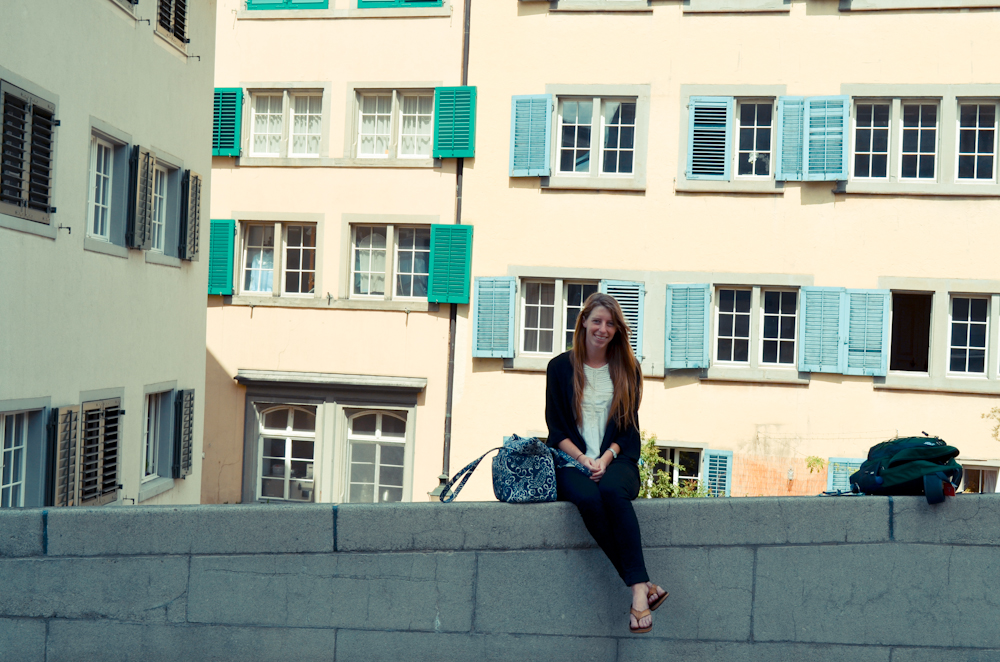


“I beg young people to travel. If you don’t have a passport, get one. Take a summer, get a backpack and go to Delhi, go to Saigon, go to Bangkok, go to Kenya. Have your mind blown. Eat interesting food. Dig some interesting people. Have an adventure. Be careful. Come back and you’re going to see your country differently, you’re going to see your president differently, no matter who it is. Music, culture, food, water. Your showers will become shorter. You’re going to get a sense of what globalization looks like. It’s not what Tom Friedman writes about; I’m sorry. You’re going to see that global climate change is very real. And that for some people, their day consists of walking 12 miles for four buckets of water. And so there are lessons that you can’t get out of a book that are waiting for you at the other end of that flight. A lot of people—Americans and Europeans—come back and go, ohhhhh. And the light bulb goes on.”
"Though she was young, she was no timid child. She was curious about things. She liked to ask questions... She had a quick mind and she paid attention, picking up phrases of the language, learning how to cook rice and eat with her hands... It intrigued her, the land and the mystery. She loved the thatched roofs and the naked children, the wonderful simplicity of village life. Her eyes seemed to glow; she couldn't get enough of it. She wasn't afraid to get her hands dirty, in fact sometimes she seemed fascinated by it. Not blood and gore so much, but the adrenaline buzz that went with her job, that quick hot rush in your veins when you had to do things fast and right. She didn't back away from ugliness; she was quiet and steady. There was a new confidence in her voice, a new authority in the way she carried herself.
Her stare encompasses everything around her, the mountains, the villages, the trails and the trees and rivers and deep misted-over valley, the hurt and the hunger, and the joy. She said, " I know what you think, but it's not... it's not bad."
"You just don't know," she said. You hide in this little fortress behind your stuff and your comfort and you don't know. Sometimes I want to eat this place. Just swallow the whole country, the dirt and the death, I just want to have it there inside me. That's how I feel. It's like... this appetite for life. I get scared sometimes - lots of times - but it's not bad. You know? I feel close to myself. I feel close to my own body, I can feel my blood moving, my skin and my fingernails, everything, it's like I'm full of electricity and I'm glowing in the dark - I'm on fire almost - I know exactly who I am. You can't feel like this anywhere else."
She said it just like that and they all just looked at her with those big round eyes, not believing a word. They don't understand zip, it's like trying to tell someone what chocolate tastes like. That's the thing. You gotta taste it. She was there. She was up to her eyeballs in it.
She came over clean but she got her hands dirty and afterwards she could never be the same. It was like an unnamed drug. The needle slips in and you know you're risking something and though it hurts, you can't stop. The endorphins start to flow, and the adrenaline, and you become intimate with the danger and the devastation. Not bad, she said. It made her glow in the dark. She wanted more. She wanted to penetrate deeper into the mystery of herself, and then that wanting became needing, and needing became craving and she had to go. She couldn't pretend she was the same.
She could look at you with this little smile in her eyes and she was lost inside herself. Lost inside the country and the people and the sadness and the joy. She was the poverty. She was the land. She was still that innocent bright eyed girl from a land far away. But now, she was on fire."
-Tim O'Brien, The Things They Carried
Such the TIA day. We drove from Ngorongoro Crater to Moshi, TZ and what our tour guide Moses told us was going to be a 5 hour drive still had us on the road 15 hours later. Africa time took on a whole new meaning. We became marginally delirious, and it led to some interesting antics. I reminded my parents of the scene in the movie SuperTroopers where they ‘meow’ at a lady during a traffic stop, daring each other to say meow 10 times. Long story short, we started meowing at Moses. All of us.
‘Meow much longer ‘til we get to Arusha?’... ‘We’ve been driving a long time meow!’... ‘Hey Meowses, will you turn up the music?’
His grasp of English isn’t the best, so he honestly had no idea what was going on. So stellar.
The next day we were off to Zanzibar. Unfortunately we had another day of being on Africa Time, and we missed the last ferry at 4 o’clock. This turned out to be kind of awesome though, because it meant we got to fly to the island. We took off on a chartered 3 passenger plane (needless to say I felt like Angelina Jolie). The flight was surprisingly smooth and we finally made it to the tiny little Zanzibar airport. Customs consisted of giving a friendly wave to a sweet old lady, and security was nonexistent.
We spent our first day on the island just relaxing at our resort and enjoying the beautiful beach, delicious Swahili food, and warm weather. The next day, we ventured to Stone Town, Zanzibar’s heart and soul. I felt lost in time as we wondered the streets of old buildings and narrow alleyways. Old men playing mancala, little girls skipping home from school, and painters depicting their surroundings filled the streets. We had to work hard to shake off a few touts (or “ticks”) who tried to sell us tours or get us to come to their shops—it was a fun opportunity to practice my sassy Swahili though… “Tafadhali niache!” (the Swahili equivalent of “You best be stepping off.”)
It was so hard to leave the little paradise of Zanzibar after just 2 days, but I’m so glad we had the opportunity to experience it.


We were heading to Ngorongoro, Tanzania, a beautiful national park that is home of the largest unflooded caldera in the world. Our new Tanzanian tour guide, Moses, told us it would be about a 5 hour drive from Nairobi to Ngorongoro. Fourteen hours later, after bribing negotiating with the gatekeepers of the national park because we were there after they closed the entrance, we arrived at the beautiful Ngorongoro Lodge. As we pull up to the front entrance, our trusty driver Charles laughs, “Oh, there is an elephant there! We can not go there!”. Assuming he’s kidding I don’t think twice until I feel the car quickly reversing. An elephant had climbed up the crater to the lodge and was standing in front of the huge glass entrance doors, just hanging out, so we couldn’t get into the hotel. I later found out that the elephant comes most days to get a drink of water, and the hotel gatekeeper politely opens and shuts the gate for it each time. What can I say? TIA.
It’s low season for tourism in East Africa (high season starts in about 2 weeks, so we’re just in the knick of time) so we basically had the amazing Ngorongoro Lodge to ourselves. We also visited the nearby Olduvai Gorge, the “cradle of humanity”. The lava rock layers there contain various human ancestors’ remains, and because the rock can be easily dated there it gives a nice little timeline and essentially proves human evolution. My dad and I were really into it and had a lot of fun learning about the history of the beautiful gorge.
Next up: Moshi, Tanzania at the foot of Mt. Kilimanjaro, then off to Zanzibar!


My parents and I headed to the Maasai Mara so they could experience a Kenyan safari. It was awesome—we saw the Big Five (elephants, leopards, rhinos, buffalo, and lions) along with all sorts of other cool animals and wildlife. I can tell I’ve been in Africa a while though; you know you’re getting jaded when you don’t even turn around in your seat to see a herd of zebras anymore.
The most interesting part of the Mara to me was visiting a traditional Maasai village. To put it delicately it was a tourist trap, but to go deeper it felt so disheartening. They tell the tourists what they want to hear (“We don’t get many visitors” “The money you give us goes to the school” “My grandfather made this bracelet [with a ‘MADE IN CHINA’ inscription on the inside]”). With so much revenue coming in from tourism, you’d think they would live in decent conditions, but unfortunately that’s not the case. The manyattas they stay in are cramped (understatement of the year), filled with smoke from their cooking fires, and dark. When you go outside to catch a breath of fresh air you’re thrown by the smell of cow dung, which litters the whole village due to their cattle sleeping in the center of all the houses every night. The dung also attracts flies, which cover the faces of all of the children. Female circumcision is a traditional rite that is still practiced despite its danger (women who are circumcised have much more difficult childbirths) and questionable regard of basic human rights. Some of the children go to school, some stay home and herd the animals. Almost no one goes to high school. Traveling to Nairobi is practically unheard of. There are no trash cans—garbage is simply thrown on the ground.
We visited the Maasai primary school, and the children were such lights. They were shy at first, but when my mom, a retired teacher, chatted with the first graders a little bit she was able to get them to open up. They showed off their workbooks and sang the ABC’s for us. It kills me that these kids won’t get to go to high school. That they return home every night to cramped houses and parents who are so bent on preserving their culture that they’ve morphed into caricatures. That they don’t have a choice.


